
Every team we’ve worked with has tools.
A task manager. A shared drive. A calendar. A WhatsApp group. Sometimes all of them at once. And yet the same thing keeps happening: work slips. Follow-ups multiply. Managers end up chasing. People stay busy, but output feels inconsistent.
It’s tempting to blame individuals. “Our team isn’t accountable.” “People don’t communicate.” “We need better discipline.”
But when we see this happening across good teams, repeatedly, it’s not a personality issue.
It’s a systems issue.
Most teams aren’t missing tools. They’re missing an execution layer.
The uncomfortable truth: tracking isn’t execution
A task manager can log something. It can assign it. It can remind someone about it.
But most tools stop right where things become hard:
-
when the assignee is overloaded
-
when instructions are unclear
-
when the task depends on two other people
-
when the task is “done” but not reviewed
-
when nobody wants to be the person who escalates
So the tool continues to “track,” while the manager continues to chase.
And slowly the team develops a culture where completion is negotiable.
Why work slips even in “high-performing” teams
Ownership is unclear
Someone says, “Can someone handle this?”
Three people react. Nobody owns it. It dies quietly.
People don’t want to escalate
Escalation is socially expensive.
So delays are tolerated until they become urgent.
The task is not a task — it’s a chain
“Onboard the new hire” isn’t one task.
It’s documents, access, approvals, introductions, policy, equipment, follow-ups.
Most tools treat this like one checkbox.
Work lives in chat, but accountability doesn’t
WhatsApp is where decisions are made.
But dashboards are where tasks go to be forgotten.
Nobody has time to manage the system
Tools require upkeep.
You need someone to structure boards, update statuses, chase updates, maintain hygiene.
Most teams don’t have the time — so the tool becomes another place where reality is recorded late.
The real cost isn’t delays — it’s the management tax
Here’s what quietly happens when execution is weak:
-
Managers spend their best hours following up instead of thinking
-
Teams become reactive
-
Small misses turn into urgent firefighting
-
People lose trust in process
-
Everyone “works,” but outcomes become inconsistent
It’s not dramatic. It’s just exhausting.
And it scales badly. The larger the team, the worse the tax.
What actually fixes this: an execution layer
When teams improve execution, they usually don’t do it by buying “another tool.”
They do it by adding a layer that ensures completion.
That layer does four things consistently:
Converts instructions into structured action
Not “noted.” Not “will do.”
Actual tasks, with owners, due times, and clarity.
Follows up automatically
Not once. Not politely.
Until the loop closes.
Escalates when work is stuck
Escalation can’t be optional.
If delays have no consequence, delays become the default.
Captures the outcome
Not just “done.”
Done, verified, logged, and visible.
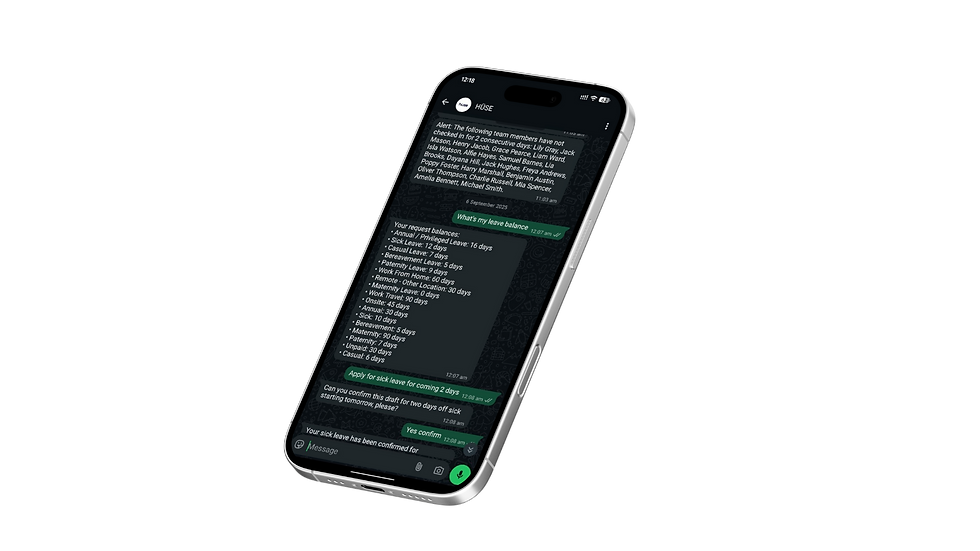
This is what execution looks like in real life.
Why chat-native execution matters
Most teams already operate in WhatsApp.
That’s not a trend — it’s reality, especially in the UAE.
So the best execution systems don’t try to drag teams into new behavior.
They embed execution into where the team already lives:
-
someone requests something in chat
-
the system structures it
-
the right person receives it
-
it follows up
-
it escalates if needed
-
it closes the loop
-
reporting becomes automatic
No dashboards required for basic execution.
No training required for daily use.
Where HÜSE fits in
HÜSE was built around a simple idea:
If work already happens in conversation, execution should live there too.
HÜSE turns everyday messages into completed work using:
-
Intent recognition
-
SOP-driven workflows
-
Assignment logic
-
Escalation rules
-
Follow-through until completion
If you’re running a team, here’s a quick test
Ask yourself:
-
Do we “track” work, or do we complete it reliably?
-
Are approvals fast, or do they depend on the mood of the week?
-
Do managers spend time leading — or chasing?
-
Do tasks close naturally — or only when someone keeps pushing?
If you’re honest, you’ll know where the gaps are.
And if you want to see what chat-native execution actually looks like, you don’t need a deck.
You can watch it run live.
.png)
.png)