Jump To Section
The Hidden Coordination Gap Between PMS, ERP and Cross-Venue Operations

Not your PMS.
Not your ERP.
Not your POS.
Meetings.
When a cross-venue operational decision needs to move inside your hospitality group, what actually happens?
A senior leader sets direction.
“Restructure weekend staffing.”
“Adjust pricing across outlets.”
“Consolidate vendors.”
“Launch the new dining concept.”
And then?
WhatsApp messages.
Email threads.
Calendar juggling.
Clarification loops.
“Let’s align next week.”
If your senior team needs a meeting to clarify every operational adjustment, your systems are not coordinating your business.
Your managers are.
And that is expensive.
Modern Hospitality Technology Stacks: PMS, ERP, POS — But No Orchestration
Today’s hospitality operations are not under-tooled.
A Property Management System (PMS) tracks occupancy and reservations.
An ERP manages procurement and financial reporting.
POS systems handle F&B transactions.
Payroll manages contracts and compensation.
Scheduling tools allocate shifts.
From a technology perspective, most serious groups are well-equipped.
The issue is not missing software.
The issue is that none of these systems coordinate cross-department execution.
They record data.
They do not route intent.
Where Cross-Venue Coordination Breaks Down
Consider a common operational adjustment.
Overtime costs are rising. The Group GM decides to restructure weekend staffing across venues.
This touches:
Operations
HR
Finance
Venue Managers
Payroll
Operations pulls occupancy reports from the PMS.
Finance checks cost impact inside the ERP.
HR reviews contract structures.
Venue managers flag local constraints.
Now clarification begins.
Finance says approval is conditional on payroll review.
HR asks whether part-time categories are affected.
Operations wants confirmation before adjusting schedules.
Someone suggests aligning next week.
Five days pass before calendars match.
One hour in discussion.
Another two days before conclusions are summarized.
Then someone asks for final confirmation.
By the time venue-level execution begins, ten to fourteen days have passed.
Active coordination time across senior staff: six to ten hours.
Elapsed time: two weeks.
And none of your core systems prevented this.
Because the problem was never occupancy visibility.
It was workflow routing.
Hospitality Leadership Structures and Approval Ambiguity
Hospitality groups are layered by design.
CEO
Group GM
Regional GM
Venue GM
Finance Controller
HR Head
All senior.
All empowered.
Without structured approval routing, authority overlaps create friction.
A decision feels approved in conversation.
But implementation stalls because finance hasn’t locked it.
Or HR needs clarification.
Or payroll requires timing confirmation.
The same instruction gets reconfirmed multiple times before action begins.
Meetings become the container for uncertainty.
This is not a communication breakdown.
It is a workflow automation and coordination architecture gap.
Decision Latency Is the Hidden Cost in Hospitality Operations
Hospitality operations do not struggle with reporting.
They struggle with execution velocity.
Small cross-functional decisions take days.
Medium decisions take weeks.
Not because they are technically complex.
Because no system owns the full flow from:
Intent
to Required Approvers
to Structured Approval
to Venue-Level Execution
to Verification
So senior managers become the routing engine.
They remind.
They summarize.
They re-confirm.
They schedule.
Multiply this across:
Shift restructuring
Vendor onboarding
Pricing updates
Marketing campaign launches
Policy adjustments
If this happens four or five times per week, senior coordination bandwidth drains quietly.
Not in visible crisis.
In accumulated friction.
That friction compounds as groups scale across venues and cities.
What PMS and ERP Systems Are Not Designed to Do
-
Your PMS is excellent at tracking guests.
-
Your ERP is excellent at tracking financial entries.
-
Your POS is excellent at tracking transactions.
-
Your payroll system is excellent at processing compensation.
But none of them are built to:
Capture leadership intent as a structured workflow.
Automatically identify required approvers.
Sequence clarifications inside a controlled approval chain.
Escalate delays without manual follow-up.
Lock approval states clearly before execution begins.
Trigger downstream actions across venues once confirmed.
So coordination remains manual.
And meetings expand to fill the gap.
The Missing Layer in Hospitality Operations: Orchestration
Hospitality does not need another reporting dashboard.
It does not need another analytics tool.
It needs orchestration.
A structural layer that sits across PMS, ERP, POS and HR systems and manages how operational decisions move.
When leadership sets direction, that intent becomes structured action.
Approvers are identified automatically based on hierarchy.
Dependencies are mapped across departments.
Clarifications are contained within a single controlled workflow.
Execution triggers only after verified confirmation.
Delays escalate without additional meetings.
Completion is logged automatically for reporting and compliance.
Managers stop being the routing layer.
Execution follows structure, not memory.
How HÜSE Introduces Orchestration Into Hospitality Workflows
HÜSE acts as an orchestration layer across your existing hospitality systems.
It does not replace your PMS or ERP.
It coordinates how cross-department decisions move through them.
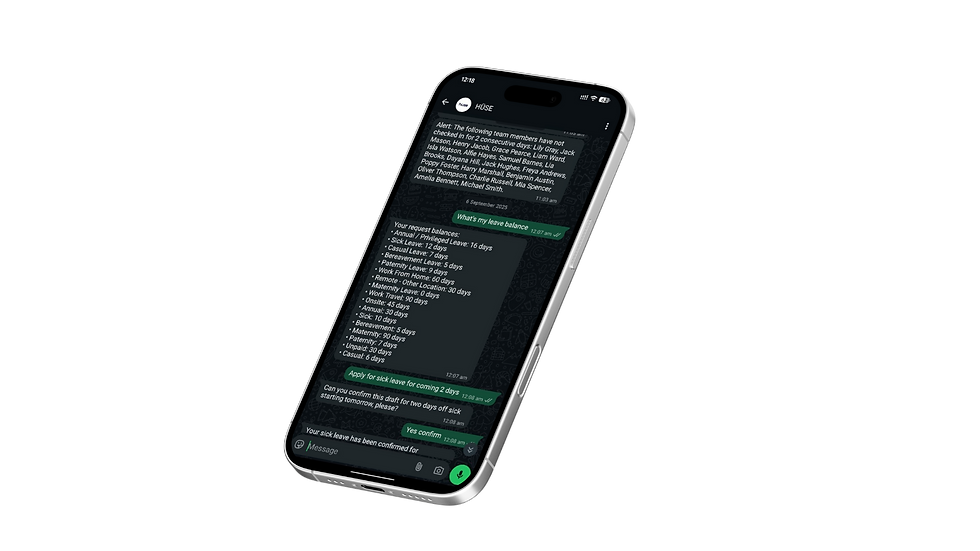
When a Group GM sets direction inside chat, HÜSE:
Maps the request against defined SOP logic.
Identifies required approvers automatically.
Routes tasks based on role and venue.
Escalates delays without manual chasing.
Verifies completion before execution is considered final.
Logs outcomes for operational reporting.
Instead of relying on follow-up meetings and clarification loops, workflow automation ensures that leadership intent translates into structured execution.
No additional admin staff required in each city.
No forced system migration.
Just coordination architecture layered on top of how you already operate.
If your hospitality group already runs PMS, ERP and payroll systems but still depends on alignment meetings to move cross-functional decisions forward, you likely do not have a technology coverage problem.
You have an orchestration gap.
And that gap is measurable.
If you’d like to see what orchestration looks like in a hospitality environment, book a 15-minute walkthrough. We’ll show how cross-venue decisions move from conversation to structured execution without ambiguity, without repeated clarification, and without adding more operational overhead.
Execution should not depend on who remembers to follow up.
It should follow intent by design.
.png)
.png)

